Showing posts with label COLUMBIA. Show all posts
Thursday, 3 May 2012
BRIDGING THE GAP
The “GAP” which this title refers to is the Darien Gap, the section of jungle between Columbia and Panama where there is no road. So, from Turbo in Columbia where the road ended Leana and I took a speed boat to Capurgana, close to the Panama border (that´s where I happily ended my last report). Since then things have become a bit warped, but not without a certain amount of excitement! We took a small boat for the short while up the coast to Puerto Obaldia (the first town in Panama). The place is a miserable little military outpost, and the immigration office is well suited to the place. Our introduction to Panama was not good – we arrived on an open boat in the pouring rain, and we were sent back to Columbia on the next available boat because we apparently required a special visa only obtainable in our home country (an extensive internet search had revealed that we required no visa for Panama). On arrival back in Capurgana the Columbians could not accept us back in their country because we had been away for 2 days – so effectively we were nowhere. The last money we were able to draw was in Turbo, as there was no ATM in either Capurgana (Columbia) or Puerto Obaldia (Panama). The back-and-forth boat trips are expensive, so we were fast running out of cash. However, after some e-mails we had a letter from the Panama consulate in South Africa, stating that we didn´t need a visa. Columbia was then able to give us a newer exit stamp, and off we went with almost our last money to Panama. This time the letter did the job, but it still took more than a day before they could manage to stamp our passports (were they waiting to be bribed?). Anyway, after camping on the verandah of the ex community centre with some other stranded travelers, we managed to arrange onward passage. There was a smallish wooden cargo boat anchored in the bay, and we found the captain drinking in the local cantina. This was apparently a good time to negotiate as he agreed on a reasonable price, and we could pay at the end of the trip (ATM about 1 hr from where he docked at the start of the road). The captain was making a killing, as there were 6 of us paying passengers (including Italian Simon, travelling by 50cc motorbike S-N, and he has already broken the record). This short boat trip took 6 days through the spectacular San Blas Islands, stopping at every sizable thatch-and-reed village to pick up empty gas cylinders and cooldrink crates. Meals were not part of the deal, so we were surprised to be offered food, starting from lunch on the first day which consisted of chicken feet on rice. There was not much difference between the 3 daily meals, and the stock meal was salted pork fat with boiled green banana. We had bought some tins of "Pork and Beans in Tomato Sauce" before the trip. Opening the tins in the hope of some sort of meal, we discovered that the contents were simply good old baked beans. Some of the crew trawled for fish, and a number of good barracuda were hauled in (the culinary highlight of the trip was the fried fish). At times the ocean was protected by the islands, and sailing was smooth. The open ocean, however, tended to be incredibly wild, and fellow passengers were puking (fortunately nobody was flung overboard, although there were a few close calls). The toilet protrudes over the back of the boat, and consists of a hole in the floor too small for a human to fall through. Don´t be concerned, we all made it to the end. Simon gave me a lift to the ATM on his record-breaking 50cc, and we settled our account with the boat captain. Now we are in Panama City, after cycling here via charming Porto Belo yacht haven, and slummy free trade zone Colon city. In only a couple of days I have had some bad luck financially (ATM in Colon did not give me cash but it was deducted anyway, and now someone has hacked into my account). Panama city is quite an interesting place, and we´ve been here a few days. Leana has bought a fancy new camera, and she has also taken her bike to a fancy bike shop to be taken care of (oh, that reminds me I should take a look at my poor bike, Old Saartjie –all that sea spray is not healthy). Now I have to give the embarrassing cycling distances. Well, after Columbia we didn´t cycle for 2 weeks, but at least now we have done 3 or 4 days on the bike. Oh yes, I´ve briefly seen the canal before being chased away by the security, and thanks to Leana for going back there on the tourist bus and getting some pics (there´s an entry fee). Daily distances cycled since we landed on a road in Panama have been:- Portobelo 44 km; Colon 48 km; Panama City 84 km; and The Canal 25 km. The total distance cycled so far on this journey is 93 172 km.
Thursday, 12 April 2012
COLUMBIAN CARRIBEAN COAST
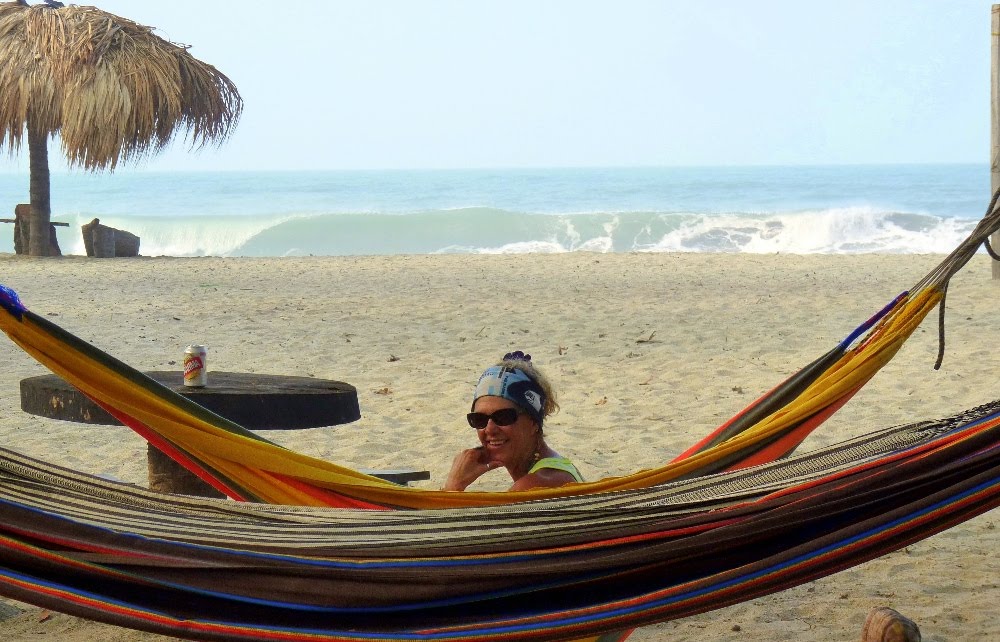
Lately I’m getting fat from all the non-cycling which Leana and I have been doing. We’ve proceeded rather slowly, roughly in a Westerly direction along the North Coast of Columbia on the Caribbean. After Leaving Taganga from where I posted my last report, we went over the hill to the city of Santa Marta, the oldest existing city in South America with the first cathedaral in the country. From Santa Marta Leana took a side trip to go trekking to the Lost City of Cuidad Perdida. After that we made our way via Barranquilla to the famous historical city and tourist attraction of Cartagena. Along the way we turned off to visit a mud-volcano where Leana coated herself in the supposedly healing muck. In Cartagena we booked into a comfortable hostal close to the historic centre, and spent a couple of days experiencing the place. The city was one of the first Spanish settlements on the continent, and the old historic part is surrounded by water and almost completely walled in. Of course, there is also a modern part to the place, which includes strips of skyscraper hotels and apartments (the hordes of tourists have to stay somewhere). The next country we’re heading towards is Panama, but there is no road through the Darien Jungle region around the border of Columbia and Panama (referred to as the Darien Gap). Most cycle tourists either take a yacht or fly from Cartagena to central Panama from where they continue with the road again. We wanted to minimize the non-cycling distance, so we decided to head for the town of Turbo, which is about as far as the road goes along this coast on the way to Panama. Last year this time we’d lost track of the date and ended up in Rio De Janeiro on Easter Weekend. This Easter Weekend we found ourselves at the little holiday towns of Tolu and Arboletes, on the Carribean. These were both wonderful bustling places, where we could see the locals having a good time on their holidays (and unlike Rio, we found cheap accommodation close to the beaches). From there to Turbo was also interesting, and although the road wasn’t fantastic at times we did stay in some really local out-of-the-way little places. Turbo itself is a hectic, dusty & muddy, smugglers haven of a port on an inlet amongst the mangroves. The place is a crazy mixture of old and modern, big trucks and horse-drawn carts share the burden of carting things to and from the boats. Well, that was the last time I’ve been on the bike. From Turbo be put the bikes on a speed-boat up the coast to Capurgana, close to the Panama border. Capurgana is a tiny picturesque village, becoming very popular amongst travelers. Now we are staying in a very nice little hotel overlooking the dock, and we even got hold of some snorkeling gear and went into the water today to take a look at all the colourful fish in the warm clear water. We’ve been stamped out of Columbia by the local immigration office, and tomorrow we’ll put the bikes on a small boat and head towards Panama. Daily distances cycled since my last report have been:- Santa Marta 7 km; Barranquilla 101 km; Santa Veronica 46 km; Cartagena 87 km; Cruz De Viso 52 km; Toluviage 100 km; Tolu 19 km; Cerete 94 km; Arboletes 86 km; Mellito 61 km; and Turbo 69 km. The total distance which I’ve cycled in South America is 26 484 km, and the total distance which I’ve cycled on this trip over the past 5 years is 92 971 km.
Sunday, 18 March 2012
BACK IN COLUMBIA


Back in Columbia, and I’m rather pleased to be in this country again. Certainly there are interesting and scenic places in Venezuela, and Leana and I enjoyed visiting some of those places as well. Since my last post from Caracas we travelled West via Maracay and Valencia back down to the coast. Nando from Spain, a fellow touring cyclist who we met along the way, has been on the road for 7 years (nowdays we seldom meet anybody who has been cycling for as long, or longer than us). We stayed over at interesting coastal towns such as Chichiriviche (how’s that for a name!?). On the way we crossed a wetlands nature reserve, where Leana took some nice pictures of birds such as the red ibis (I still don´t have a proper camera). We stayed over for a couple of days in the historic colonial town of Coro, where I managed to get my grubby paws on some half decent new tyres for a change (I’d had to sew up tyres with fishing line at the roadside – again!). Just before we reached the second largest city in Venezuela and centre of their oil industry, we camped on the deck of a restaurant over lagos Maracaibo (the largest lake in South America, where a lot of their oil is pumped from). The restaurant was busy closing up for the night as we took over, and before we could even pitch our tents amongst the tables we were presented with drinks and a big plate of fried fish each. There is a huge bridge over the mouth of the lake to the city, but bicycles are prohibited so the police put us on the back of a flat-bed truck with a maniac driver. Again, we risked our lives on narrow un-maintained and overgrown roads fighting for space with the ancient throbbing American monster cars. Soon after crossing the border back into Columbia we reached another scenic stretch of Carribean coastline. In the isolated region of Cabo De La Vela the local indigenous people grill goat meat and corn cakes at roadside stands, and we got stuck into that tough delicacy as well. I say 'WE' because after about 30 years of vegetarianism, Leana has become carniverous and she is rather keen to try all the things she has missed during that time. Amongst other places we stayed in a crazy roadside hostal in the bustling tiny village of Palomino, where the local indigenous people come and go together with budget travelers from South Africa (us), Iran, Canada, France, UK, USA, and so forth. We camped on the beach at a small sort-of resort after that, where I could lie and listen to the crashing waves and crashing coconuts falling around (we made sure not to camp directly under any of the coconut palms!). Now we’ve made our way a little further West along the coast to the so-called “backpacker magnet” of Taganga, a former hippie hangout (and before that just a very scenic little fishing village). The city of Santa Marta is just a few k’s away over the hill, and we’ll move that way tomorrow when we leave here, as I need to have some things done to my bike (poor old Saartjie is hanging in there by the skin of her teeth). Daily distances cycled since Caracas have been as follows: La Victoria 103 km; Maracay 49 km; Naguanagua 72 km; Tucacas 95 km; Chichiriviche 42 km; Mirimire 84 km; Puerto Cumarebo 97 km; Coro 43 km; Dabajuro 134 km; Santa Rita 137 km; Mojan 77 km; Maicao (Columbia) 90 km; RioHacha 82 km; Palomino 96 km; Buritaca 38 km; and Taganga 51 km. The total distance which I’ve cycled so far in South America is 25 762 km, and the total so far on this journey is 92 249 km.
Thursday, 1 December 2011
THE RIO META


I was desparate to get some decent info before heading through Eastern Columbia along the Rio Meta towards Puerto Carreño and the Venezuelan border. I was aware that the river was widely used for transport, but due to the flood plains of this big Orinoco tributary the map indicated that I would usually be quite a distance from the water. However, locals don´t travel all the way along this route, and I was told that the road was anything from 200 to 350 km long (or just far). For 2 days I battled along a terrible bumpy and dusty road, and I found it better to cycle on paths alongside the road where possible. Then 2 things happened:- I branched off that road onto a series of jeep-tracks and footpaths, and the rain started. Often over the following days the water stood so deep that I couldn´t make out the track I should be cycling on. I had many spectacular falls during that time. There were also many times when I had to drag my poor old bike through sucking black swamps, destroying my sandles in the process. Unfortunately my camera didn´t survive all the falls and the water, so the last picture I took on this section is the one where my bike is lying in the road on a good day. However, a strange thing happened, and I picked up a Blackberry in the middle of nowhere the day after my camera broke (it seemed slightly damaged and didn´t seem to be in working order, but I kept it anyway). I lost my way quite a number of times, as it was often diffucult to decide which one of a maze of tracks was the actual highway. So much for complaining. This part of the country is cattle-ranching land, and I camped at farmsteads quite a number of times. I found the farm people and the cowboys to be wonderful people, and they were more than willing to accommodate me. Without fail I was offered food as well, usually before I could even pitch my tent (always under the cover of their roof, to shelter from the rain). There is only one proper town about half-way along this route, an interesting place called Prima Vera. I stopped in there to do some shopping, and before I knew it a crowd had gathered and I was being interviewed by the local TV channel who followed me all the way out of town with their cameras. All along the way I still couldn´t figure out how far the end of the road at Puerto Carreño was, so I just made sure that I had enough food with me for a few days, but clean drinking water started to become a problem in some isolated areas later on. I imagined that I was bullet-proof, and a few times I drank water from suspect sources. As can be expected, the suspect water took it´s toll and caused me to become extremely ill, not being able to take in any food or drink for a couple of days (eventually I collapsed at a farmhouse early one day, where I lay until the following morning when I felt strong enough to continue). After what seemed like forever, 750 km later, I rolled into Puerto Carreño where the local Fire Brigade have been happy to evacuate an office where I´ve been able to camp for a couple of days. Further, I´ve been able to charge the battery of the Blackberry which I´d picked up, and I was happy to find that at least the camera still works (so I am able to take some simple pictures). Daily distances cycled since I last reported distances from Cali have been:- Andalucia 122 km; Armenia 90 km; Cajamarca 37 km; Ibague 78 km; Fusa 103 km; Bogota 63 km; Villavicencio 90 km; Puerto Lopez 109 km; Puerto Gaitan 115 km; Matanegra 57 km; Karim Aguas 54 km; Finca Carillo 68 km; Finca Marabre 44 km; Finca Virgen 58 km; Prima Vera 31 km; Santa Barbara 60 km; Antiguaneuvo 56 km; La Vendicion 74 km; Rio El Chiqui Chaque 62 km; La Esperanza 46 km; Finca Tienda 65 km; Puerto Carreño 75 km. The total distance cycled in South America to date is 19 317 km, and total for the trip is 85 804 km.
Wednesday, 16 November 2011
LA LINEA
I´d had a nice 2 days rest in Cali, South Western Columbia, where I had enjoyed the hospitality of Miller and his family at their Casa De Ciclistas (the morning I left Miller wasn´t there to see me off, and the girl in picture is an Argentinian cyclist who arrived the day after I did). From Cali most touring cyclists head roughly North via Medellin to Cartagena on the Columbian Carribean coast. However, I took a major diversion, heading East towards the Andes Range again, and to the capital of Columbia, Bogota. Before reaching the Andes I cycled through the picturesque coffee-growing area around the town of Armenia, where I camped in the rain in a field close to a farm house (and the people came out with supper for me, as well as breakfast the following morning). Then it was the mean steep climb in the rain up the Mountains again - called La Linea in these parts. As if the hill wasn´t enough, I has some trouble with punctures, going through all my spare tubes in the process. Just after the summit at an altitude of 3 300 m I had to repair a tube, and I took shelter in the simple house of some mountain people in order to do the job (they were very friendly and excited about this chance visit, they called me ¨Señor¨and kept offering me coffee). But that wasn´t the end of the mountains! Typically the road went way down again past Ibaque, and then I had to climb up to Bogota which is situated at an altitude of 2 600 metres. It was raining again as usual, but I found refuge at the wonderful La Candilara branch of the Fire Brigade (they moved one of their trucks so I could camp in the garage, they gave me food, and when I left the following morning I was presented with an official Bogota Fire Brigade T-shirt and cap). After another climb out of the city, the road dropped from 3 000 metres to an altitude of 100 m in about 100 km to the city of Villavicencio. From Villavicencio I had a wonderful new flat road of about 200 km to the bustling river port town, called Puerto Gaitan. I knew that my good-road experience was about to end, but nobody could give me any decent info on what lay ahead to the East. I bought 2 off-road tyres anyway, because I had a feeling that I would need them. (Cycling distances are included in the following post).
Subscribe to:
Posts (Atom)