Sunday, 4 November 2012

JEWEL OF THE EMPIRE


Tomorrow morning Leana, my cycling partner, leaves on a vacation to visit her family in South Africa. She flies off from Mexico city, so we left our bikes and stuff at the Pacific coast in Acapulco and took the bus over the mountains to the centre. She had to leave last week already, but her flight was via the USA and due to the storm her original flights were cancelled. Mexico city is huge (population 20 million), and is also interesting in various ways. At the height of the colonial era, Mexico City was seen as the “Jewel of the Spanish Empire”.
In keeping with this status, the largest cathedral in Latin America (1573) stands in the city centre, facing the expanse of the Plaza De La Constitucion (the 3rd largest city square, after Tienamen Square in Beijing and Red Square in Moscow). Facing the square (commonly known as the Zocalo) on the other sides are more colonial buildings such the the Palacio Nacional. There seems to be a constant hum-drum and commotion around the large attractive historic centre. There are scores of beautiful historic buildings and monuments in the area, also the Palacio De Bellas Artes and the Monumenta A La Revolucion.
However, there is also a modern aspect to Mexico City, and historic architecture is often reflected off modern glass structures.
Whenever possible I like to check out the metro rail systems in large cities, and this city has a modern underground rail (also partly above ground, and sometimes overhead) with about 10 main lines criss-crossing the city. During our time in the city we went all over the show on the metro, travelling on about half of those Metro lines. Quite incredibly, one can travel the whole day on one ticket, changing lines at junction stations, as long as you don't exit a station (then you have to buy another 3 Peso ticket (1 US dollar is 13 Pesos).
When we arrived in Mexico city we booked into a nice "fairly economic" hotel (thanks to Leana), with a room overlooking the happenings on Calle 5 De Mayo. We quickly took cameras and started roaming the streets amongst the festive weekend crowds. Before long one of the street clowns caught sight of Leana, and fooled around with her a bit, much to the amusement of the locals.
When Leana's flight was cancelled we spent the extra time by taking a trip down to the city of Veracruz, on the Carribean coast. Veracruz was the first colonial town established by the Spanish in Mexico. It is a sizeable port, with a fort at the far side of the harbour which history has shown to be quite ineffective. The place also has some nice colonial buildings in the historic part of town, where we stayed.
Along the way our bus took us past the highest peak in Mexico, the vulcan Pico De Orizaba at 5 636m. So, when Leana leaves I will make my way back to my bike and things in Acapulco, and carry on alone from there. I wish her a happy holiday.

Friday, 26 October 2012

LOCO IN ACAPULCO


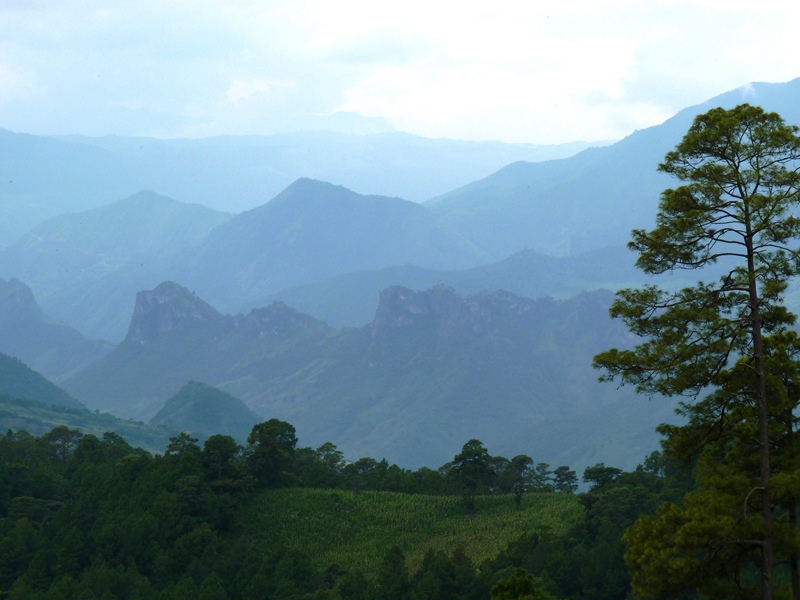
Eventually Leana and I have made it to the Pacitic coastal city of Acapulco. Since my last report we crossed more of the ever-present Sierra Madre mountains, before reaching the Pacific. Although the mountains slowed us down and strained our legs a bit, there were good views along the way.
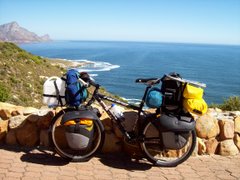
Oh Yes, let me interrupt myself here! It may not seem like much to anybody else, but me and my faithful bicycle (Old Saartjie) have now clocked up 100 000 km on this trip (one hundred thousand kilometres!). The bike clock went to 99 999, and then reverted back to 0!
Once we had descended to the coastal plains, we passed many average Mexican towns which were interesting to us due to their lack of tourism (finding a budget room could become tricky, what with all the pay-per-hour places along our way). It was around that area that we passed the real “Isthmus of Mexico”, the narrowest part of land which is also a virtual wind tunnel between the Carribean and Pacific. No surprise then that there are huge electricity-generating wind farms in the area, with appropriately named worker-towns like La Ventana.
The road West along the Pacific coast often diverted a bit inland over the hot and humid sequence of seemingly endless hills. Fortunately the roadside was pleasantly flavoured by flowering plants of many colours.
Then we reached Mexico's famous "surf-town" - Puerto Escondido, where we took a day off. The waves here are legendary, and surfers from all over the world flock to Zicatela beach for the powerful barrel ride. In that area we also stayed over at local beaches in "palapa rooms", such as at Roca Blanca and Barra De La Cruz.
On our approach to Acapulco we took the coastal route, thinking that it would be less hilly. Well, surprise, surprise! To get into the city we had to cycle over yet another gigantic hill above Puerto Marques and the neighbouring wealthy suburbs below us on the slopes, where our tortured sweat flowed.
The attraction of Acapulco is the beach, relaxation, and the night life, but there is also the famous cliff divers. We went to see these men diving from up to 35m into a narrow and fairly shallow gully (they first have to climb up the cliff from the water into which they dive).
Now Leana leaves for a "holiday" in South Africa. I will accompany her by bus to Mexico city from where she flies, and then I will return to Acapulco from where I will continue cycling alone. Distances cyled since last time were:- Tuxtla 16 km; Cintalapa 83 km; Tapanatepec 80 km; Juchitan 111 km; Morro Maratan 73 km; Barra De La Cruz 94 km; San Pedro Pochutla 72 km; Puerto Escondido 70 km; Roca Blanca 45 km; San Jose 48 km; Pinotepa 61 km; Cuajinicuilapa 57 km; Mariquelia 66 km; San Marcos 81 km; Acapulco 76 km. Total so far in Mexico is 2838 km. Grand total is 100 383 km.

Sunday, 7 October 2012

TABASCO HEAT & SIERRA MADRE

Since my last post Leana and I left the city of Merida on our way West (and we picked up our USA visa's on the way out). Within a couple of days we were in another historic colonial city, this time the coastal city of Campeche, where we spent a day looking around and photographing restored history. From there we cycled along a very scenic stretch of the Mexican Gulf coastline, where the road mostly ran only metres from the ocean. We also crossed a number of big bridges in the area, the 3km and 4km long causeways to- and from Isla Del Carmen, as well as bridges over various large rivers. Until fairly recently there were no modern roads in the region, and river transport prevailed. Mexico has a large oil industry, with refineries and oil rigs visible from the coast.
We followed this coastal road as far as the town of Paraiso, past Isla Del Carmen and Frontera into the Tabasco State.
Then we headed South, trying to cut through the depression in the narrow part of the country in order to avoid the mountains on our way to the Pacific coast. Somewhere along the way my odometer also clocked over to 99 000 km.
In the process we visited more Mayan ruins at Comalcalco, and at the Tabasco state capital, Villa Hermosa, we went to Parque De La Venta where we looked at ancient Olmec artifacts (including the famous giant heads carved from basalt rock). There were also some captive local animals in the park, such as the jaguar in picture. Moving on South we also stayed over at Teapa in the pouring rain, and took a tour deep into the spectacular caves just outside of town.
Then the trouble started, the dreaded Sierra Madre mountain range. Luckily the road doesn't cross the highest part, but we caught the edge of it, and that was fierce enough!. After some time in the flat humid jungle and coastline, these hills were a wake-up call. However, on the bright side, the scenery was spectacular, we passed through amazing rural villages where the indigenous ways are still strong, and the climate was nice and cool for a change.
Now we have dropped down to the lowlands on the Pacific side of this narrow part of the country, and we'll head on to that coast from here. Currently we are taking a break at another historic colonial town, Chiapa De Corzo, which is close to the Chiapas state capital, Tuxtla.
Daily distances cycled since my previous post have been:- Maxcanu 67 km; Campeche 121 km; Champoton 67 km; Sabancuy 71 km; Cuidad Del Carmen 87 km; Frontera 100 km; Paraiso 81 km; Villa Hermosa 81 km; Parque De La Venta 7 km; Teapa 71 km; Tapilula 80 km; Nuevo Pueblo Solistahuacan 36 km; Bochil 40 km; and Chiapa De Corzo 69 km. The total distance I've cycled in Mexico so far is 1785 km, and the total distance which I've cycled so far on this trip is 99 330 km.

Wednesday, 19 September 2012

MOVING ON IN MEXICO

Just a note to say that I'm in Mexico, and not at ease in Belise any more. In fact I've already cycled more than 800 km in Mexico, in the Yucatan region (that's the big lump in the South-east of the country which juts out into the Carribean). This is not the classic cactus desert Mexico of old cowboy movies, but rather a humid, flat, tropical jungle for the most part. There are some huge resort cities such as Cancun and Playa Del Carmen, as well as some very colonial cities such as Merida, where Leana and I are right now.
There are also some famous Mayan sites such a Chichen Itza which Leana went to visit, but I didn't bother. The two of us split up for a few days, but then we met up along the road again later. I camped at some interesting places during that time, such as in the centre of a village next to what I thought was a ruin (in fact part of the building was still a functioning church, and the following morning when they opened the side door for some fresh air I struck camp to a chorus of Hail Mary's). There are so many foreign tourists around this area that the locals hardly look at one twice. There are also sinkholes around the area (called cenotes) where people can swim and go on floating underground tours as there is a whole network of underground rivers. Along one hot deserted stretch of road we found a deep well from which I managed to extract some cool fresh drinking water (luckily I didn't pull up one of the floating tourists). There is a lot of Maya archaeological sites around this area, as well as many current Maya villages with many live Mayans wandering about. Mexico is a mix of Spanish and Indigenous, even the conquestadors used the stones from Mayan structures to build their own buildings. Just down the road here in Merida is a church where one can actually still see Mayan carvings on the stones in the outside wall. We have been in Merida for a few days now in order to apply for the USA visa, as there is a consulate here. We were not all that hopeful about getting a USA visa, as we are supposed to apply in our home country (this consulate is for Mexicans and immigrants to apply for visas). However, we tried our luck and arrived at the consulate armed with loads of copies and documents to hopefully strengthen our case. Well, we were rather surprised when none of that stuff was necessary, and our visa was approved without any ado. This past weekend the locals had their independence day celebrations, with fireworks and endless parades - they also have the little stalls all over the show selling national pride paraphanalia such as flags and colourful sombreros. We found a good bike shop here and Leana bought a bunch of new parts which I fitted to her bike. Now I'm cleaning up her old parts to fit to my bike (they're as good as new). We still have about another 5 months in Mexico, and this is a big country, especially when one is on a bicycle. Distances cycled since my last update from Belize have been:- Corozal (Belize) 53 km; Chetumal (Mexico) 27 km; Limones 94 km; Filipe Carillo Puerto 67 km; Tulum 115 km; Cancun 108 km; Chiquila 128 km; Kaua 113 km; Piste 22 km; Izamal 76 km; and Merida 70 km. The total distance cycled so far in Mexico is 807 km, and the total distance cycled on this trip is 98 352 km.