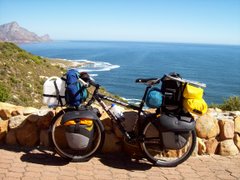
Four years on the bike, and I find myself celebrating by repairing 2 punctured tubes (which by now I could probably do with my eyes closed and my hands tied behind my back!). Let me rather say something about Brasil, where Leana and I have been cycling Northwards along the coast for the past 2 weeks. For starters, Brasilians are a difficult bunch to describe, as there doesn't seem to be anything like a typical Brasilian. This lot comes in all shapes and sizes, they are all colours of the rainbow, they wear anything they want (sometimes hardly enough), and everyone seems to be happily doing their own thing. Some people live in fancy condo's and glittering mansions, while others live in shacks and on rubbish dumps. Streets are shared by shiny black 4X4's and horse-drawn carts (the other day I was able to help a stranded cart-man by giving him one of my spare tubes). Bicycles are popular here, for sport as well as transport to the supermarket or to work. People are generally friendly, with lots of hooting and greeting and sometimes shouting (fortunately we don't understand the language much, but some of it may be related to the popular Aguardente cane spirit - I've tried the stuff myself, only because it is dirt cheap!). When we entered the South from Uruguay the land was very flat, with a lot of lakes and rice and cattle ranching. Gradually the environment has become more tropical in nature, with forested hills and a warmer humid climate. The other night we suffered a rather heavy rain-storm which demonstrated to Leana that her tent needed some serious water-proofing treatment (fortunately I'd given my old tent the treatment in Australia already). We're struggling a bit with the Portuguese language, which we mostly confuse with the bit of Spanish which we'd picked up in the previous 3 countries (as soon as we open our mouths people here assume that we're Argentinian). In the South there was a lot of interesting colonial architecture, and we also battled head-winds most of the time (we made the most of the couple of days when the wind was in our favour). Currently we're in the historic city of Joinville, about half-way between the Uruguayan border and Rio De Janeiro. One really good thing about Brasil is that they eat a decent breakfast - bread, cheese, ham, fruit, and cake! (in comparison to the measly croissant and coffee in the previous few countries). We've camped all over the show, but thanks to Leana we have stayed in budget hotels a number of times, where breakfast has always been included. Daily distances cycled since my last report have been:- Curral Alto 90 km; Pelotas 157 km; Camaqua 133 km; Guaiba 103 km; Osorio 125 km; Capao Canoa 47 km; Torres 63 km; Ararangua 60 km; Tubarao 81 km; Imbituba 57 km; Tujucas 129 km; Barra Velha 85 km; and Joinville 57 km. The total distance I've cycled in South America so far is 7 394 km. The total distance cycled in the 4 years of this trip is 73 881 km.
Monday, 28 March 2011
SOUTH-COASTING BRASIL
Four years on the bike, and I find myself celebrating by repairing 2 punctured tubes (which by now I could probably do with my eyes closed and my hands tied behind my back!). Let me rather say something about Brasil, where Leana and I have been cycling Northwards along the coast for the past 2 weeks. For starters, Brasilians are a difficult bunch to describe, as there doesn't seem to be anything like a typical Brasilian. This lot comes in all shapes and sizes, they are all colours of the rainbow, they wear anything they want (sometimes hardly enough), and everyone seems to be happily doing their own thing. Some people live in fancy condo's and glittering mansions, while others live in shacks and on rubbish dumps. Streets are shared by shiny black 4X4's and horse-drawn carts (the other day I was able to help a stranded cart-man by giving him one of my spare tubes). Bicycles are popular here, for sport as well as transport to the supermarket or to work. People are generally friendly, with lots of hooting and greeting and sometimes shouting (fortunately we don't understand the language much, but some of it may be related to the popular Aguardente cane spirit - I've tried the stuff myself, only because it is dirt cheap!). When we entered the South from Uruguay the land was very flat, with a lot of lakes and rice and cattle ranching. Gradually the environment has become more tropical in nature, with forested hills and a warmer humid climate. The other night we suffered a rather heavy rain-storm which demonstrated to Leana that her tent needed some serious water-proofing treatment (fortunately I'd given my old tent the treatment in Australia already). We're struggling a bit with the Portuguese language, which we mostly confuse with the bit of Spanish which we'd picked up in the previous 3 countries (as soon as we open our mouths people here assume that we're Argentinian). In the South there was a lot of interesting colonial architecture, and we also battled head-winds most of the time (we made the most of the couple of days when the wind was in our favour). Currently we're in the historic city of Joinville, about half-way between the Uruguayan border and Rio De Janeiro. One really good thing about Brasil is that they eat a decent breakfast - bread, cheese, ham, fruit, and cake! (in comparison to the measly croissant and coffee in the previous few countries). We've camped all over the show, but thanks to Leana we have stayed in budget hotels a number of times, where breakfast has always been included. Daily distances cycled since my last report have been:- Curral Alto 90 km; Pelotas 157 km; Camaqua 133 km; Guaiba 103 km; Osorio 125 km; Capao Canoa 47 km; Torres 63 km; Ararangua 60 km; Tubarao 81 km; Imbituba 57 km; Tujucas 129 km; Barra Velha 85 km; and Joinville 57 km. The total distance I've cycled in South America so far is 7 394 km. The total distance cycled in the 4 years of this trip is 73 881 km.
Friday, 11 March 2011
A BRAAI IN URUGUAY

Asado (a.k.a. barbeque, or "braai" in South Africa) is about as big in Uruguay as it is in Argentina. Leana and I have also found other similarities between the two countries, such as the love of football, the drinking of maté, staying up late at night and taking siesta in the day, the Spanish language, and there is even pampas grass along the road. From Buenos Aires we took a ferry across the wide expanse of the Rio De La Plata estuary to Colonia in Uruguay. We camped there in the local campsite that night, and were rather disappointed at the cost of the camping and also the price of things in the supermarket. The bit of Argentinian money we´d changed didn´t last long, so the following day we stopped at an ATM in the small town of Colonia Valdense. Well, what a co-incidence, as we bumped into Jo at the ATM and she invited us home to meet her South African daughter (Abegail) and son-in-law (Andrew). A couple of years ago Andrew sailed his yacht from Cape Town across the Atlantic, and the family cruised the S.American coastline for some time until they crept ashore for the arrival of offspring number 2. We got chatting over a few beers, so they insisted that we stay for supper and we ended up camping on their lawn that night. Andrew referred us to his Irish/English friend Lawrence (and Uruguayan partner Elisa) in Pireapolis, so a few days later we camped on their lawn and were invited to stay another night for a braai. The braai turned out to be a mean ex-pat affair, with Swedes, Americans, English, Canadians, and other South Africans all sending up the smoke. (The other South Africans were Pierre and Lindi from Durban, waiting for something to be done about their damaged yacht which had run onto the rocks). Uruguay is quite a small country, but we did manage to do a few other things as well. We stayed in the capital, Montevideo, for 2 days checking out the historic sights and so forth. Further East we passed through the international tourist mecca of Punta Del Este (reminiscent of Patong Beach in Phuket, Thailand). "Punta" is officially the end of the Rio De La Plata, and the start of the Atlantic Ocean (the first time my bike - Old Saartjie - had seen the Atlantic in almost 4 years). There are some nice beaches along this coast, and we camped at one or two of these. At the frontier town of Chuy (Chui in Brasilian) we crossed into Brasil. More correctly, we were stamped out of Uruguay 1 km South of the town where we spent the night "incognito", and we checked into Brasil the following morning about 1 km North of town. Officially the border runs along the middle of the dual main road in Chuy (the road is called Av.Brasil on the Uruguayan side, and R.Uruguay on the Brasilian side). Now we´ve moved a bit further into Brasil, just so that we´re less confused - at the border they seem to speak a mixture of Spanish and Portuguese, and the price of things in the shops is indicated in both Uruguayan Pesos and Brasilian Reals. In the process we´ve been welcomed into Brasil by the pouring rain - apparently there has been some serious flooding further to the North. We´ve decided to remain in our comfortable room in the town of Santa Vitoria Do Palmar for another day, as right now it is still pouring outside. Daily distances cycled since my last report have been:- Colonia De Sacramento 12 km (plus 3 hr ferry); Colonia Valdense 58 km; Playa Pascual 93 km; Montevideo 37 km; Pireapolis 110 km; La Barra (Punta Del Este) 52 km; Rocha 91 km; La Esmeralda 74 km; Chuy (Brasil border) 80 km; and Santa Vitoria Do Palmar 25 km. Total distance cycled in South America so far is 6 207 km. Total distance cycled so far on this trip in nearly four years is 72 694 km.
Wednesday, 23 February 2011
AT HOME IN BUENOS AIRES
After more than a week in the city, Buenos Aires is starting to feel like home to Leana and me. But let me start at the beginning. Arriving in town after dark the previous night. we were keen to get out in the morning and experience this vibrant place. Buenos Aires is a huge city with a population of over 13 million, and the high density built-up area extends way beyond the microcentro (city centre). We walked down busy malls like Avenida Florida with craft markets and living statues, and marveled at the attractive colonial buildings in the historic city centre around Plaza De Mayo, also the famous theatre and Govt buildings. We dashed across the Av 9 De Julio (possibly the widest boulevard in the world, with its famous central obelisco), and stared at the "Pink Palace" where Evita had enchanted the crowds from the balcony (we subsequently visited her grave in the Ricoleta cemetery where people still leave flowers). In the afternoon we sat down at a pavement cafe, and that's where disaster struck - before we could place our order, Leana's bag disappeared from under the table between her feet (glasses, camera, cash, and bank cards: All gone!). So now, while we wait for the bank to send a new card, we're almost becoming citizens of Buenos Aires. (Fortunately Leana could transfer some money to my "poor" account to keep us alive in the mean time - and my sister also helped out). As I've mentioned however, one could be stuck in worse places than this. Besides all the history, there is a new "skyscraper" section towards the riverfront called Puerto Madera. We also visited the colourful La Boca district (and the Boca Juniors football stadium) where we met some famous people and entertained the crowd by dancing the tango. Besides getting around on the convenient subway system, we also took the regular suburban train out to Tigre on the Parana river delta at the outskirts of the city (and had a picnic on the riverbank). From here we're planning to take the ferry across the Rio De La Plata to Uruguay - but we're still waiting for Leana's new bank card to be delivered (and she's ordered new glasses from an optician around the corner). This whole episode is costing a lot of money - not only the hotel and replacement costs, the brazen thief actually managed to use her credit card a number of times. At least the place is colourful and interesting, with cheap Ugi's pizzas on the corner, and the ever present Parilla's (steak houses). I can also understand why people here need Siesta - they seem to stay up just about the whole night!
Sunday, 20 February 2011
PEDALING THE PAMPAS
The plains of central Argentina are generally referred to as the "Pampas", named after the plumed pampa grass (this grass is also infamous all around the world for swallowing golf balls). From Mendoza at the foot of the Andes Leana and I had to cross the Pampas in order to reach Buenos Aires on the East coast of Argentina. Around Mendoza there were still wine estates for a while, but from there on the roadside scenery was mostly cattle ranches and huge maize and soya plantations. Soon after leaving Mendoza the road deteriorated to a narrow strip without shoulder, which could not accommodate two trucks and a bicycle side-by-side. Unfortunately for us the road was rather busy with trucks all the way, which meant that we often had to fly off into the roadside grass - only returning to the black-top once the danger had passed. The rear-view mirror I'd fitted to my bike in Chile turned out to be a necessity, and Leana also invested in this "life-saver" along the way. However, for me there were other problems - certain ageing parts on my bike decided to retire from duty during our crossing of the Pampas. Within 3 days both my rear hub and the front hub caved in - luckily there were OK bike shops in nearby towns where I could buy the necessary spares, but it meant staying in a room for the following day so I could replace the hub. Regarding the road conditions, San Luis province was the exception, with a dual highway and a hard shoulder on one side (sometimes we cycled with the traffic, and sometimes against it). In that province they even had street lights all the way along the road, the paint colour of the poles changing after every 2-dozen or so (in one instance there was still some red paint left over, so they painted a tree). In Pategonian Argentina and in Chile the wind had been predominantly from the West, so we were hoping for that pattern to continue and blow us all the way to Buenos Aires. No such luck! The prevailing breeze was either from the SE or the NE, and most afternoons it was straight into us from the East. No complaints, as there were practically no hills and the Argentinians along the way are very pleasant people. Besides their friendliness there are a number of things which are remarkable about these people, i.e. they ritually suck on a herbal tea called "mate", they sleep for most of the afternoon (siesta - mostly at home where they have special darkening blinds on the windows, but also in parks, etc., see last pic.), and they love to eat barbequed beef (asado). Along the way we camped in public parks, on the porch of a vacant house, in picnic areas, and mostly at petrol stations (which, incidently have barbeque areas - and showers). One Sunday afternoon we pulled into a picnic area along a small river where half the population was grilling meat over fires - and before we could even pitch our tents various parties had arrived with plates of meat for us (and they all wanted their photo's taken with us). Even the vegetarian Leana consumed some meat ("so as not to offend the people, she said"). One non-Argentinian we met was fellow cyclist Nobu from Japan, who camped with us at a petrol station - heading in the opposite direction. We followed the National Ruta 7 almost all the way, but we diverted to Ruta 8 in order to visit the historical town of San Antonio (where Leana and her sisters had been on an Argentine holiday more than 7 years ago). From there we made the dash for the big city, and after a while the narrow road suddenly turned into a highway (we noticed some signs prohibiting cyclists, but they let us pass at the tollgate and we took our chances). So, in the late afternoon of Tuesday the 15th we sped into Buenos Aires on a 12-lane expressway, boosted by a rare tail-wind like two meteorites in our bright Aussie "safety shirts". Remarkably we made it quite a way into this large city before the highway patrol caught up with us, and loaded us into their van (oh yes, football is a major religion in Argentina, and while we were being removed from the highway our driver exhibited a tattoo on his chest - the emblem of his favourite football team). We were released into the regular rush-hour traffic, where we battled the thousands of busses and taxis for another 10 k's until after dark, when we found a nice hotel in the city centre (thanks to Leana). (Please see following report regarding our stay in Buenos Aires). Daily distances cycled since Mendoza have been:- Las Katitas 106 km; Alto Pencosa 99 km; San Luis 20 km (+30 km lift due to broken bike); Villa Mercedes 85 km; Washington 96 km; Laboulaye 128 km; Rufino 71 km; Vedia 119 km; Junin 58 km; Carmen De Areco 126 km; San Antonio DA 66 km; and Buenos Aires 118 km. Total distance cycled in South America since November last year is 5 575 km. Total distance cycled on this trip since leaving Cape Town on 27 March 2007 is 72 062 km.
Wednesday, 2 February 2011
CROSSING THE ANDES
In order to get from Satiago De Chile to Argentina Leana and I had to cycle across the imposing Andes mountains (also referred to as the Cordillera). Crossing the Andes required some hard pedalling up from Chile - the gradual uphill started soon after we left Santiago, with some big hills closer to the border (one sequence of switchbacks had about 30 bends - each one numbered, but the numbers were increasing as we climbed so we had no idea where it would end!). From Santiago we took the direct highway to the town of Los Andes, and were driven through a 3km long tunnel by the highway authorities. At the top of the mountains there is another tunnel at an altitude of 3 185 m, where we were also taken through by van from the Chilean side (the border is in the middle of the tunnel). In the following 2 days we cycled through a number of shorter but narrow tunnels - the Argentinians obviously aren't as concerned about our safety as they were in Chile. We also passed a number of ski-resorts on our way up and down on both sides (strange to see the deserted hotels, unused ski-lifts, and exposed stony slopes where there is a thick bed of snow in winter). The descent on the Argentinian side of the "Cordillera" is spectacular desert-like scenery, and we also had a good view of Aconcagua (the highest peak in the America´s). The road on the Argentine side was mostly downhill almost all the way to the city of Mendoza where we are now. Mendoza is a pleasant city with wide leafy streets and attractive plaza's, and is also the centre of the Argentine wine region - which reminds me of an over-sized Stellenbosch in SA. We'll rest here for a day or two before heading East across the Pampas in the direction of Buenos Aires. Distances cycled since my previous report from Santiago were:- Los Andes 81 km; Portillo 51 km; Puente Del Inca 40 km; Uspallata 71 km; Potrerellos 58 km; and Mendoza 72 km. Total distance cycled on this journey is 70 970 km. Total in South America so far is 4 483 km.
Friday, 21 January 2011
EXTRA CHILE
When I cycled South from Santiago 2 months ago, the last thing I expected was to be cycling the 1000 odd k´s North again on the Pan Americana, back to Santiago. However, the trip was quite pleasant as it was a nice change to have Leana cycling with me again, and we took it much easier (Leana was worried about her foot injuries, which fortunately didn´t give any trouble on the bike). On the way South I´d put in some long days, mostly camping along the road. Now we moved North along the same road, turning off to towns along the way in the afternoon where we usually booked into the local accommodation. This provided a better insight into how the people live, and most of these towns are quite pretty - usually designed around a picturesque central plaza with trees, band stands, and statues of Heroes. Speaking of heroes, every town in Chile has a street named after Bernardo O´Higgins (the Liberator), Pedro Montt, Manuel Bulnes, and Arturo Pratt (amongst others). In the South there is a lot of German influence, and many of the buildings tend to be constructed from timber with shingles on roofs and external walls. In Puerto Montt we stayed in such a 3-storey leaning timber hostal, and the day before we left we were shaken by an earthquake (fortunately there was no damage, as the wooden buildings are supposed to be fairly earthquake resistant). However, further North in Middle Chile, it was sad to see the extent of the damage caused by the huge earthquake in Feb 2010. In towns such as Chillan, Linares, and Talca we had a hard time finding cheap accommodation as those places tend to be older buldings which were destroyed (reminiscent of Padang in Sumatra where we were about a year ago). However, those earthquake-stricken places are in the famed Chilean winelands, and it is quite a scenic area to cycle through. I´ve taken a liking to the cheese in Chile, and in certain places such as Loncoche and around Temuco we got stuck into some tasty cheese bought at the stalls along the road and in the local markets. Now I´m back in Santiago for the second time in about 2 months (and more than 4000 km later). Leana hasn´t been here before, so on the first day here we wandered around the city taking in the sights. Unfortunately the air is much more hazy now than it was 2 months ago, and one cannot really see the towering mountain (the snow has melted now, anyway). I also got some necessary bike spares and I spent yesterday servicing Old Saartjie. Our intention was to get back on the road tomorrow, but Leana´s computer is buggered and she handed it in for repairs, only to be collected on Monday pm! So, now we´ll hopefully leave here on Tuesday (25th), and head North-East towards the Andes and Argentina. In the mean time we´ll probably still be cruising around the city on the cheap and efficient underground metro rail. Daily distances cycled since my last report were:- Puerto Varas 20 km; Frutillar 44 km; Osorno 69 km; Los Lagos 94 km; Loncoche 86 km; Temuco 88 km; Collipulli 102 km; Los Angeles 77 km; Chillan 113 km; Linares 109 km; Talca 56 km; Curico 73 km; Rancagua 112 km; and Santiago 92 km. Total distance cycled in South America is 4 110 km. Total distance cycled on this trip since leaving Cape Town on 27 March 2007 is 70 597 km.
Subscribe to:
Posts (Atom)